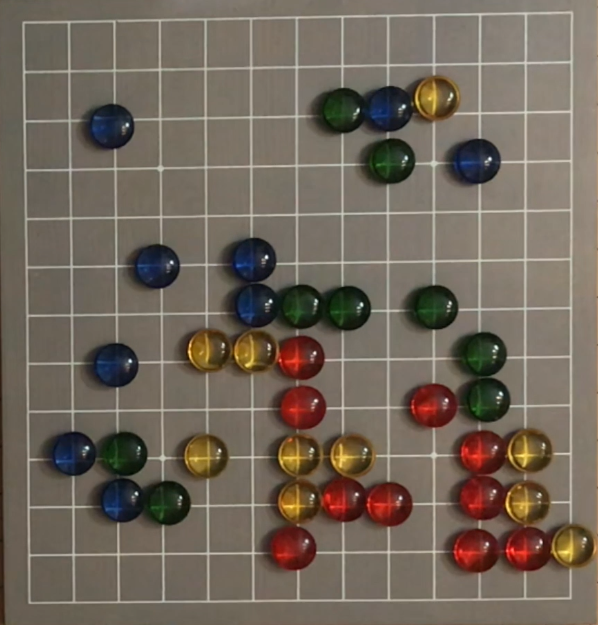
4-Color Go
The set in the video was bought in the Six Brothers Baduk store in Seoul, South Korea. For a long time, I wanted to try 4 Colors Go and finally I had found the perfect set. Surprisingly, the foreigners who were studying with me at BIBA all thought that the set was kind of ugly, that the colors would damage the players’ eyesight since they were so shiny, it seemed to be a blasphemy to the black-and-white classic setting we find in normal Go.
At first, I regretted buying the kit because nobody seemed to want to play. But that changed after some games I played with my friend Simão Gonçalves. I had anticipated some weird patterns to arise during play but the game totally exceeded my expectations.
Unfortunately, the video is in Portuguese, so you might not be able to understand what I try to explain there. However, don’t worry, I’ll go through the main points here instead.
There is a manual with the case, but I can’t read Korean — I guess it’s just a souvenir of my failed attempts to learn the language last semester —, so I came up with some rules by myself. The first one is about how to start: if you let people start in the corners, they will just play ultra-defensively because you cannot control fights when 3 opponents play in advance. To counter boredom, I suggest, then, starting with a crosscut in the center, with the player having the least space the first one to play (I do this sort of wrongly in the video).
The second part of gameplay which changes is liberties. All colors can take liberties from one another so it takes some time to get accustomed to counting them. In the video, there are only two players, each one having two diagonally opposite colors, so the player can make the colors help each other, nevertheless, attention to the fact that allied colors can still take away liberties is very important.
Ko’s change considerably from classic Go. If you take the more general rule of not repeating the board position and apply it to 4 Colors Go, it means that 3 players can capture the ko before it becomes illegal. One of the ways this changes the flow of the game is related to ko threats: the threat could be relevant to one of the colors, but not to the other — for example, one color might be able to answer the ko threat effectively, while the other, less so —, which can lead to the ending of the ko midway through its first cycle, quite the oddity.
Maybe the most important revolution is about life and death. Here, I believe it’s much more adequate to use the Chinese rules principle of “it’s only dead if you can capture it”, simply because in 4 Colors Go there is no need to make two eyes in order to live, you only need to make the capture impossible. As an example, during the video, in the end, we have that it is impossible to capture the yellow group in the lower left because it made sort of two eyes with the green stones. I have to confess, though, that I don’t know the general shapes for living in this game yet. But it seems to be a bit richer than normal Go, since you can live in more than normal ways.
In my outstanding career of three wins and no losses, I’ve humbly had no need for counting, winning all games by knockout, but I guess the problem of counting might be relevant to some. I would recommend that the captured stones should be counted as minus points for the captured color, and not as fractions of a stone to the player who did the capturing. The real issue, though, is to account for the territory in-between different colors. The only reasonable — and natural, in my opinion — solution here should be to count this no man’s land as nobody’s, that is, dames. Usually, these empty spaces will result from captured stones, so the compensations should be the minus points for one or more of the players.
After this quick introduction to a game I openly state I don’t understand, I hope you take a look at the video to experience how it looks, I know it’s not the best footage, but it’s what I managed to do at the time. Lastly, I would like to highlight that this beauty of a game, not only unknown but very underappreciated by the Go community overall, is a lot of fun to play and definitely worth the somewhat stiff price of around 150 dollars (I think that was the price…). Get yourself some variety from Go without really changing the core of the game! I guarantee it will at least be a great game for betting!