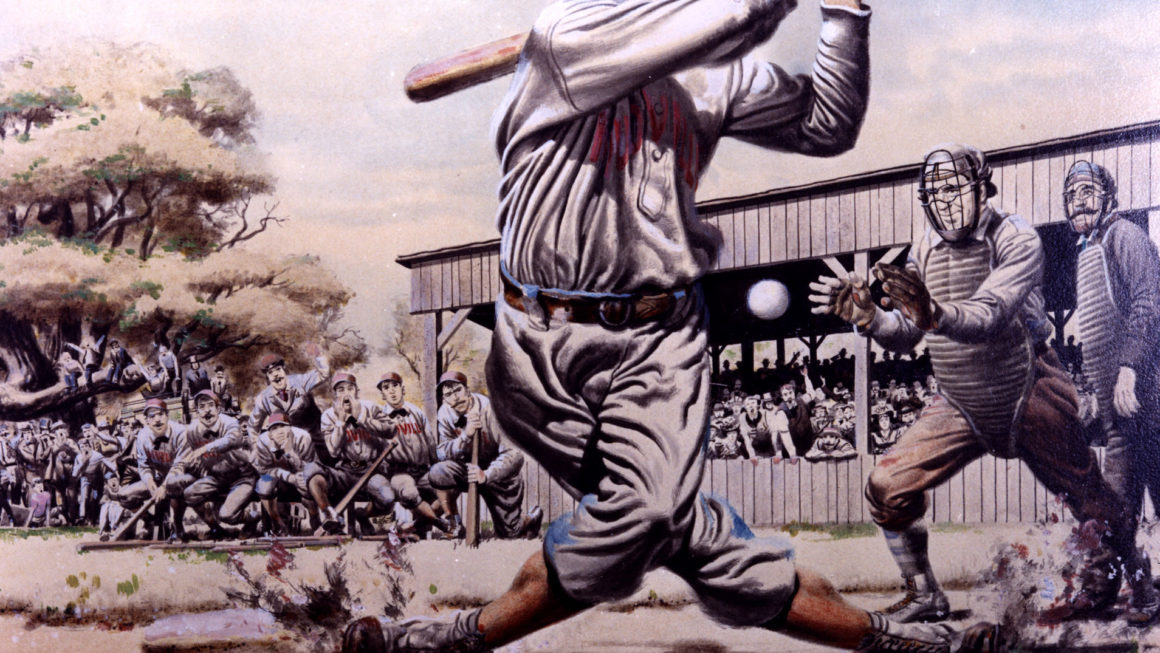
Casey at the Bat
Today I would like to register here one of my favorite literary pieces, one that struck me so hard, it makes me openly jealous: one day I would like to compose a similar masterpiece. Casey at the Bat is one of the most famous and cherished American poems but I’ve read many critics diminish its value due to its topic, baseball. I couldn’t disagree more with them, the technical mastery underneath the ballad and the accuracy of the emotional description is true genius, it should be on par with topics such as love or whatever the philosophical trend values the most.
The poem was created by Ernest Thayer, under the pseudonym of Phin, and published in 1888, in The San Francisco Examiner. The structure of the ballad follows thirteen quatrains (stanzas of four lines) in the less standard AABB rhymes, instead of the more usual ABAB and makes extensive use of iambs, seven per line. What’s that? Iamb is a verse metric, used in Greek and Latin, consisting of a short sound followed by a longer one. In English, it translates into an unaccented syllable followed by an accented one. One example would be:
Tŏ stríve, tŏ séek, tŏ fínd, ănd nót tŏ yíeld (Ulysses, by Alfred Tennyson).
Iambs make sounds much more pleasant and addictive, and that’s one of the reasons for the poem’s popularity. I would argue you can even find iambs inside the title:
Căséy ăt the Bát
A clearer example would be the first line of the poem:
The ŏutlook wásn’t brĭlliant fór the Mŭdville nínĕ that dáy.
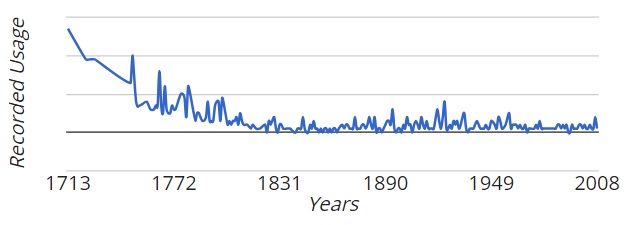
Not surprisingly, the concept of iambs seems to be directly correlated with the popularity of traditional ballads, as we can see from the graph in the Collins Dictionary
Thayer also makes extensive use of alliteration in his verses, which helps to give onomatopetic value to the descriptions:
| It rumbled through the valley, it rattled in the dell; | Alliteration of r’s and d’s to mimic rumbling and rattling, in line 18. |
| Like the beating of the storm-waves on a stern and distant shore | Alliteration of s’s and t’s, for the beating of the waves and the hisses of the water, in line 34. |
Now, on to the story of the poem. It could perhaps be argued that its
storyline is somewhat cheesy: a bad scenario is created just so the
hero could save the day with his or her prowess. But, might I add, if
that’s cheesy, then humans are all the cheesier, after all, these
situations happen all the time both in life and books. Anyway, one
only needs to read the last stanza to realize that even Thayer seems
to want to mock those who wish to take him or the genre
seriously
The outlook wasn’t brilliant for the Mudville nine that day;
the score stood four to two, with but one inning more to play.
And then when Cooney died at first, and Barrows did the same,
a sickly silence fell upon the patrons of the game.
A straggling few got up to go in deep despair. The rest
clung to that hope which springs eternal in the human breast;
they thought, if only Casey could get but a whack at that —
they’d put up even money, now, with Casey at the bat.
But Flynn preceded Casey, as did also Jimmy Blake,
and the former was a lulu and the latter was a cake,
so upon that stricken multitude grim melancholy sat,
for there seemed but little chance of Casey’s getting to the bat.
But Flynn let drive a single, to the wonderment of all,
and Blake, the much despised, tore the cover off the ball;
and when the dust had lifted, and the men saw what had occurred,
there was Jimmy safe at second and Flynn a-hugging third.
Then from five thousand throats and more there rose a lusty yell;
it rumbled through the valley, it rattled in the dell;
it knocked upon the mountain and recoiled upon the flat,
for Casey, mighty Casey, was advancing to the bat.
There was ease in Casey’s manner as he stepped into his place;
there was pride in Casey’s bearing and a smile on Casey’s face.
And when, responding to the cheers, he lightly doffed his hat,
no stranger in the crowd could doubt ’twas Casey at the bat.
Ten thousand eyes were on him as he rubbed his hands with dirt;br
five thousand tongues applauded when he wiped them on his shirt.br
Then while the writhing pitcher ground the ball into his hip,br
defiance gleamed in Casey’s eye, a sneer curled Casey’s lip.br
And now the leather-covered sphere came hurtling through the air,
and Casey stood a-watching it in haughty grandeur there.
Close by the sturdy batsman the ball unheeded sped —
“That ain’t my style,” said Casey. “Strike one,” the umpire said.
From the benches, black with people, there went up a muffled roar,
like the beating of the storm-waves on a stern and distant shore.
“Kill him! Kill the umpire!” shouted someone on the stand;
and it’s likely they’d have killed him had not Casey raised his
hand.
With a smile of Christian charity great Casey’s visage shone;
he stilled the rising tumult; he bade the game go on;
he signaled to the pitcher, and once more the spheroid flew;
but Casey still ignored it, and the umpire said: “Strike two.”
“Fraud!” cried the maddened thousands, and Echo answered fraud;
but one scornful look from Casey and the audience was awed.
They saw his face grow stern and cold, they saw his muscles strain,
and they knew that Casey wouldn’t let that ball go by again.
The sneer is gone from Casey’s lip, his teeth are clenched in hate;
he pounds with cruel violence his bat upon the plate.
And now the pitcher holds the ball, and now he lets it go,
and now the air is shattered by the force of Casey’s blow.
Oh, somewhere in this favored land the sun is shining bright;
the band is playing somewhere, and somewhere hearts are light,
and somewhere men are laughing, and somewhere children shout;
but there is no joy in Mudville — mighty Casey has struck out.
The poem was an instant hit and it was featured in many
vaudevilles
On a final note, it’s going to be very difficult to emulate such mastery of the genre, especially because I’m not a native English speaker, but I promise I’ll do my best. Maybe in a month or so when I get a more relaxed schedule I might be able to channel my inner poet into the task; I can already feel poetry about dragons fighting on a Go board brewing somewhere. But until then, enjoy Casey, his epic poem and his even more epic failure.
- Casey at the Bat, Wikipedia.
- Casey at the Bat Analysis, Shmoop.
- Iamb (Poetry), Wikipedia.