
Python Basics, Eratosthenes and Problem 51
At university, I mostly used two programming languages: C and Matlab.
The former was mostly for the first two years and the norm for math
courses, the latter would be much more to the students’ taste, since
it is in a higher level, i.e., easier to work with. From my experience
a hundred-line code in Matlab would easily be more than a thousand
lines in C and that really makes a difference when it comes making
things work first and, only later, worrying about optimization. And
that’s exactly Python’s
For Machine and Deep Learning, the most widely used language is a
seemingly never-ending debate between Python and R. The latter is a
statistical more old school language, an inheritance of a prior
language, S
After deciding what language to focus on, I looked for a systematic
way of adapting my knowledge of other languages to the new one and
also learning its unique properties. And what better way than doing a
course…
Anyway, you can find the notes I’ve taken throughout the course in
This problem comes from a site called Project Euler, which aims at stimulating the practice of programming and mathematics. In it, you will find hundreds of challenging problems that require creativity, logic and a basic (usually) amount of programming.
After looking for a challenge that I could code in one or two days, I bumped into this peculiar problem of replacing digits — it’s actually not really unusual, most of the basic problems there deal with manipulating primes. It goes like this:
By replacing the 1st digit of the 2-digit number *3, it turns out that six of the nine possible values: 13, 23, 43, 53, 73, and 83, are all prime.
By replacing the 3rd and 4th digits of 56**3 with the same digit, this 5-digit number is the first example having seven primes among the ten generated numbers, yielding the family: 56003, 56113, 56333, 56443, 56663, 56773, and 56993. Consequently 56003, being the first member of this family, is the smallest prime with this property.
Find the smallest prime which, by replacing part of the number (not necessarily adjacent digits) with the same digit, is part of an eight prime value family.
Frankly, I suck at manipulating numbers: primes, modulo and digits have never ever been my thing. So when I was faced with this problem, my thought was process was to just make a brute force search. The idea would be to simply find all the possible combinations of digits to be replaced, check if the numbers were primes and see if the family size is bigger than 7. Let’s see if it works…
After having the primes, we can finally tackle the problem itself. I chose to first create a list with all the possible combinations of n digits, apply them to the prime being checked and see if it generates a big enough family. So, for example, if the algorithm is checking numbers with 5 digits, it will have to go through:
\[C_{5,5} + C_{5,4} + C_{5,3} + C_{5,2} + C_{5,1} = 1 + 5 + 10 + 10 + 5 = 31\]
I chose to store the combinatios in a list and make the number being
checked a dictionary
          comb = []
for L in range(1, len(indexy)):
  for subset in itertools.combinations(indexy, L):
    comb.append(subset)
comb_list = [list(i) for i in comb]
prime_collection = []
new_numb_dict = {a:b for a,b in
                  zip(dict_of_number.keys(),
                  dict_of_number.values())}
This is, admittedly, very dumb. Many combinations will be checked repeatedly, but I had made a decision to have something working first rather than optimizing something I wasn’t sure would work. Now, we go to the main part of the code; we need to replace the digits in the combinations, check if they’re prime and, if so, add them to the family, which will be checked for its size in the end:
          for i in range(0,len(comb_list)):
  prime_collection = []
  # Replacing the numbers according to the combinations
  for j in range(0,10):
    for k in comb_list[i]:
      new_numb_dict[k] = j
  # Transform into number
  list_new_numb = [i for i in new_numb_dict.values()]
  new_numb = int("".join(map(str,list_new_numb)))
  # Check if prime
  # Need to exclude numbers with leading '0'
  if new_numb in primes_N and len(str(new_numb)) == len(str(n)):
    prime_collection.append(new_numb)
  new_numb_dict = {a:b for a,b in
                    zip(dict_of_number.keys(),
                    dict_of_number.values())}

  # Need to include the original number and exclude copies
  prime_collection = list(set(prime_collection))
  # Length of the prime collection searched
  if len(prime_collection) >= len_51:
    print('\n',n)
    print(comb_list)
    print(comb_list[i])
    print(prime_collection)
    return
print("Sad! No numbers found to solve the problem!")
Checking all of the combinations grows very fast as the number of digits increase, thus, even though it takes less than expected, the amount of time needed to find it is a bit absurd compared to solutions mathematicians would come up with: an hour. And that is without computing the primes first. After trying to run the sieve for primes up to 1,000,000 — you need primes up to 10x if you want to work with x digits — and watching my computer almost melt, I chose to download a pre-calculated list on the internet.
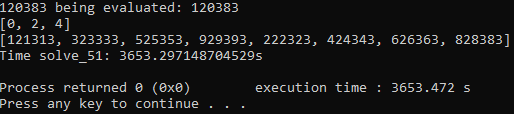
It was quite the challenge to solve this problem, not really due to the mathematical difficulty but to my struggles with the language, since I was still too much of a beginner; if you want to check out my complete code, you can go to this Github Repo. And if you would like to see a more optimized and sophisticated approach that only takes 0.25s to find the answer, check this post from the Dreamshire’s blog.
First, we need a way of generating primes. And probably the most efficient way — there are some formulas to get families of primes but they only work for a restricted amount of them — to do it is with the Sieve of Eratosthenes, an ingenious algorithm invented in Ancient Greece by Eratosthenes of Cyrene — he is best known for being the first person to calculate the circumference of the Earth. Essentially, you’re going to use the prime found to sieve out all of its multiples. For example, we first scratch out all of the multiples of 2, then of 3, then of 5, and so on. Naturally, the only numbers left will be primes.
Two classic improvements have also been added to our code: firstly,
you need only to check numbers above and including the square of the
prime being checked, because the numbers below it will either have
been already scratched out by prior primes or are primes; and,
secondly, you only need to check multiples of numbers up to the root
of the biggest number in the list, since the ones above it will be
checked during the algorithm
The core part of the code is very simple, it would look like this in Python:
          for j in range(i**2,N+1,i):
  try:
    numbers.remove(j)
  except:
    continue