
Why Your Main Argument Against Socialism/Communism Is Wrong (Probably)
For probably about 10 years I've been hearing this fallacy, and I
cannot believe it sometimes comes out from some quite erudite people;
lately I've been hearing it even from more intellectual Youtube
channels such as
China Uncensored
— of which I'm a subscriber and fan. The typical phrasing is
something like "that's what you get for choosing communism
Okay, okay... you're gonna say that, as statements of facts, those are more or less correct, because communism or socialism did kill a lot of people. However, whenever people invoke those arguments, the comparison to the status quo, i.e. some variation of capitalism, is definitely implicit and, as we will see, that does lead to false conclusions.
I usually don't even know where to start with this kind of reasoning and end up sounding like some sort of anti-capitalist or flat out strike organizer. But, before you think I'm a staunch supporter of socialism or brutal dictatorships, let me tell you that I'm not: I'm, at best, a fan of logic. And that's the core problem here: sponsoring this fallacy is playing — often unconsciously — on emotions to sell the propaganda of an economic system, not analyzing the facts.
Pressured by external and internal forces, the government would be forced into taking more and more extreme actions, killing many of its citizens in the name of the revolution and implementing an atmosfere of extreme distrust and censorship.
To which revolution am I referring?
Usually people blatantly tag socialism or communism as something inherently wrong and, thus, bound to fail. However, it is only an ideology, a plethora of ideas, and these ideas are only as extreme as the ideal capitalism some hypocritical economists seem to propagate as reality. A perfectly autruistic society probably never existed (for long), and there will probably never be a perfectly balanced market either, so long as there are cheaters in this world or so long as we let businesses influence politics.
These plethoras of ideas need to face reality at some point and that's how they fail; and fail hard sometimes. For example, we haven't yet been able to even conceive a market where the government would not have to correct the course in which companies regularly abuse their power to the detriment of the people.
Mostly, these implementation failures come from the ideas' neglect of many other important variables. In the case of communism, the biggest variable theories underestimated was corruption: the infamous politburos would not, in the end, fight for the people, but rather for their own interests, with infinite attempts at perpetuating their own power.
Despite this not so mentioned implementation flaw, there is another huge variable shallow analysts and the biased media seem to ignore frequently: outside influence. Can anyone imagine the pressure the USSR must have faced by going against the entire world and institutionalizing a completely different system? Every day there would be numerous attempts at destabilizing the government, and from completely different countries. No wonder the KGB quickly became the most powerful secret agency.
Little by little, the capitalist world chipped away the allure of socialism — through words or products — from the Russians, Slavs, Eastern Germans, and others. Little by little did the USSR increase their surveillance and punishment to those who spoke ill of the system.
To prove that this phenomenon is not an exception, a very specific instance or something else entirely, let's take a look at an "entirely different situation": the French Revolution of 1789. An analogous pressure was felt among the rebels with respect to the outside influence: all over Europe, monarchies would soon flock to the rescue of French royalty, fearing the spread of such a rebellion. The disgraced royalty would try to gather forces in order to undo the coup d'état. Little by little, an atmosfere of distrust ensued and the rebels had to gradually and quickly take more and more severe actions against anyone who would dare doubt them. Throughout the continent, from various countries, powerful politicians would declare the revolution an abomination, a new system that usurped the glory nobility perpetuated. Sounds familiar? If you're still rooting for the main fallacy: your cries against socialism could have sounded as strange to future humanity, as the nobles' cries against democracy and capitalism back then.
Only 5 years after the revolution, Robespierre, one of its most renowned leaders, was executed by the guillotine. About a decade after the start of the whole chaotic ordeal, Napoléon Bonaparte would be crowned the Emperor of France. Somehow, it should seem miraculous that most of the world lives under democracies and not monarchies. Somehow, we have convinced ourselves that the exact same phenomenon was brave in the context of the French Revolution and hideous, logically invalid in the context of the USSR.
Both contexts are different and I'm not here to defend the Stalin's brutalities on the back of the French Revolution. But it should be flagrant that people seem to inflate brutalities when the outcome is bad and deflate them when things turned out to be successful.
If deaths could comprise the hardship and complexities of living under economic systems, we wouldn't really need a debate, we would just (carefully) count them and game over. But deaths are just a huge oversimplification; and, even though I do agree that communism has really gone to extremes never before seen during Stalin and Mao, it would be very naïve or ill-intentioned to ignore the terrible background capitalist feats when it comes to the quality of living.
It is true that the current system has managed to improve our lives beyond our wildest imaginations — if you have the money that is... —, however this was not simply only an achievement of will or intellectual prowess on the part of the most developed countries, it was mostly built on the backs of the millions and billions living in the poorest countries. In the last century, the rich bathed in comfort while poverty was exported to the far away corners of the world, in Southeast Asia, Africa and South America.
The most notable case of hypocrisy is probably the abusive British
colonial rule of India. The English would regularly exploit the
country for food, causing huge famines in various regions and in
different periods. The current estimate of the number of deaths is at
35 million people. This no small number, it's doubling
Hitler's
Famine or no famine, Indians will breed like rabbits.Winston Churchill
Winston Churchill was even worse than you imagine when it comes to Indians. After refusing American and Canadian food aid to India and being asked why — food supplies to Europe had already been sent —, he replied: "if there is a shortage then why is Gandhi still alive?"
History will be kind to me, for I intend to write it.Winston Churchill
Another less known brutal ruler was Leopold II of Belgium. During the colonial European rush of the late 1800s, Belgium managed to get its hands on Congo, where a brutal system was imposed, leading to internal wars and, again, huge famines. In total, it's estimated that Belgium has managed to destroy up to 15 million lives — mutilation of children included — as a result of either direct actions or the sponsorship of internal conflicts.
To further illustrate that deaths as a metric system is completely
incompetent for the argument, we can also mention the South American
dictatorships dating from the 1960s to the early 1990s. While trying
to fight USSR's influence in the continent after the Cuban disaster,
the USA undercut its own principles and sponsored several coup d'états
all over the continent
The main reason people can't seem to get their numbers right is related to what was discussed in the previous section: only deaths caused by conflicts approved by the status quo seem to make the bill.
If you sum the deaths caused by iconic communist dictators, the total
is probably around 100 to 120 million
On the other hand, when summing up only some of the major conflicts capitalism has caused throughout more or less the last 150 years, the total can easily surpass the socialist counterpart:
- 40 million: World War I
-
55 million: World War II. Should I mention the fact that both World
Wars were mainly caused by capitalist strife between Europeans? Or
that many huge US companies helped the Nazis, only stopping when the
government forced them to?
- 10 million: Leopold II of Belgium's rule of Congo (I'm trying to be a bit more conservative than 15 million)
- 35 million: Indians lost by famine during British rule
- 4 million: Indians lost by famine due to increased British food demand in World War II
The list is only a brief summary of some conflicts and we are already
at 144 million deaths for capitalism. I've even ignored plenty of
other conflicts in the Middle East, the abominable European economic
wonders slavery provided, and all of the nastiness the Japanese Empire
(1868 - 1947) caused Southeast Asia from the beginning of the 1900s to
1947. It's also not at all difficult to imagine another 100
million
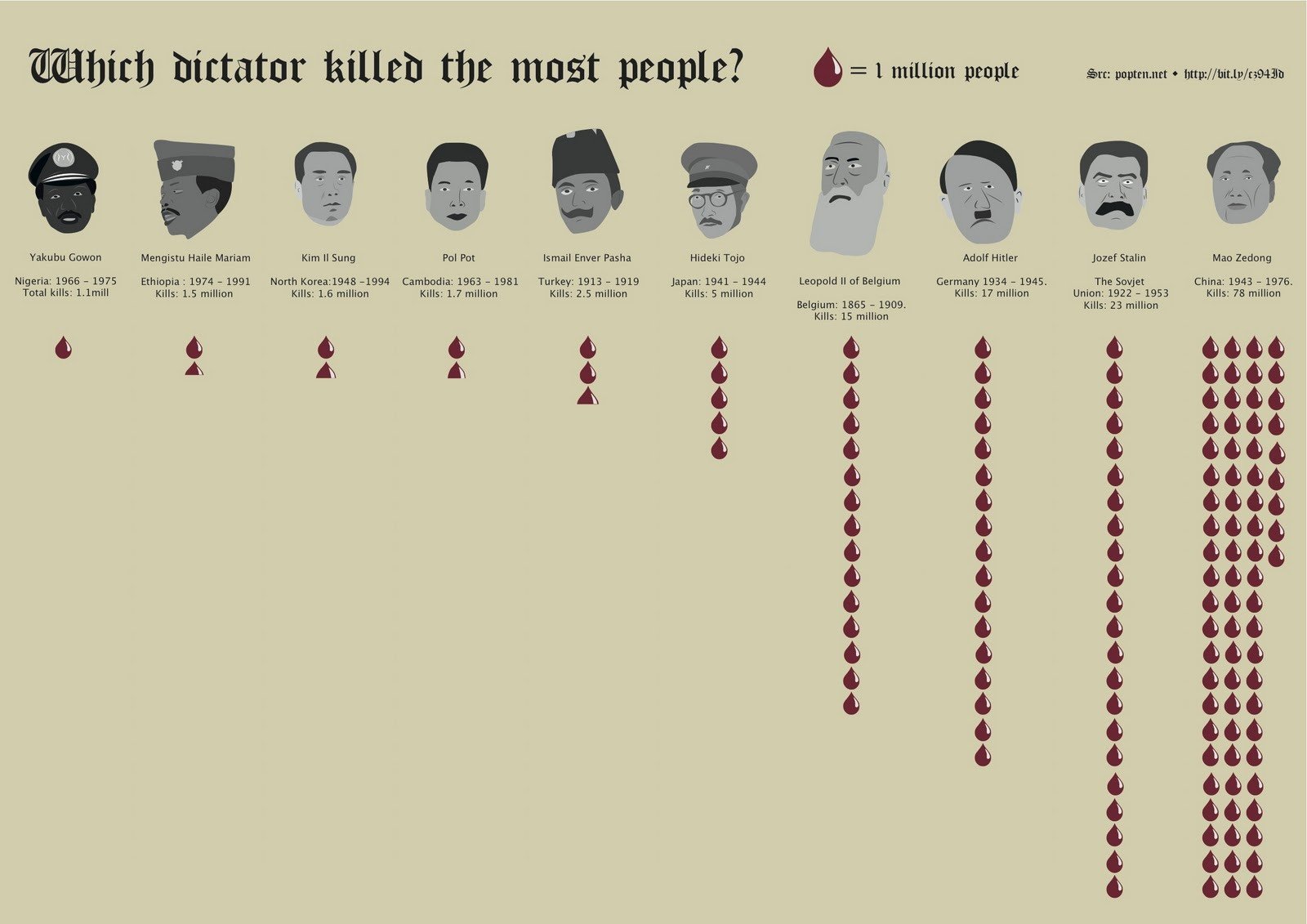
People should care very little if you don't like socialism, communism or capitalism, they are only choices on the spectrum. Ultimately, all of those systems have worthy goals, worthy ideas, despite the implementations' faults. Nevertheless, what you should definitely care about is if the reason for the dislike comes from emotion or propaganda, instead of logic. The moment you fall into the trap, it won't be you or your reasoning who's in control, but rather the (powerful) people who want to perpetuate the(ir) status quo.
In sum, all I have to ask is: if you wish to continue arguing against socialism or communism, be my guest, but do it with another argument, a logical one this time.
- If Communism Killed Millions, How Many Did Capitalism Kill?, by Umair Haque on Medium.
- The Nightmare of Valve's self-organizing "utopia", by Ong Kar Jin on Medium.
- Condemn communists' cruelties, but capitalism has its own terrible record, by Owen Jones on The Guardian.
- German car company 'used hair from Jews murdered at Auschwitz', by Allan Hall on The Telegraph.
- Who Killed More: Hitler, Stalin or Mao?, by Ian Johnson on The New York Review of Books.
- Research Starters: Worldwide Deaths in World War II, The National WWII Museum, New Orleans.
- 10 Famous Companies that Collaborated With Nazi Germany, by Khalid Elhassan on History Collections.
- Hitler's Willing Business Partners, by Jack Beatty on The Atlantic.
- The Differences Between Communism and Socialism, by Robert Longley on ThoughtCo.
- India in World War II, Wikipedia.
- Congo Free State, Wikipedia.