
The Insufficiency of the Right (and, therefore, of the Left?)
Insufficiency regarding what? It could be related to many aspects, however, this discussion will be restricted to a criterion that usually benefits nations broadly: economic growth. There will be no fooling ourselves, though, that economic growth automatically grants us with absolute progress and happiness, nonetheless, it can be observed that it correlates considerably well with better living standards.
To alter the direction of the economy, both the Right and the Left have numerous mechanisms, but the essence orbits around the fundamental question of wealth distribution. The Left defends, almost always, an explicit and forced redistribution of income, which manifests itself, also almost always, through government programs; while the Right defends the opposite, an absence of such programs, equipping themselves with the argument that the economy would have self-regulation mechanisms embedded, and artificial controls would cause malfunction and inefficient behavior. This liberalist rhetoric has its roots in the works of important philosophers and economists such as Adam Smith and Friedrich Hayek, but would a free market really be the best path for the economy?
What has been seen throughout the last 40 years is a no – the philosophers of the past oversimplified reality; just as we abandoned the erroneous ideas about physics of the ancient Greeks, we should do the same with those of the more recent philosophers also. The two main evidences which attest these excessive simplifications are two extremely important statistics: the world’s GDP growth; and wealth concentration (which is deeply correlated with income inequality, the more common statistic).
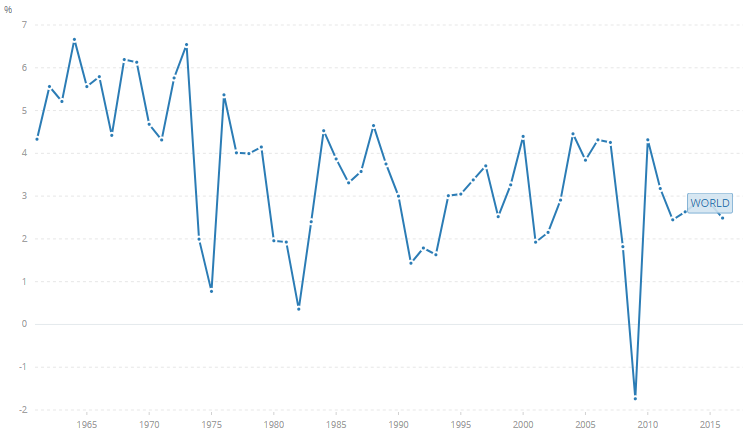
According to the graph provided by The World Bank, it is possible to conclude that neoliberal policies widely implemented since the 1970s — facilitated by and together with globalization — have completely failed to maintain or increase the world’s economic growth — with an honorable mention to the only negative point of the graph, thanks to the close to effectively inexistent stock market regulation in the USA (and in the world generally) a bit before 2008.
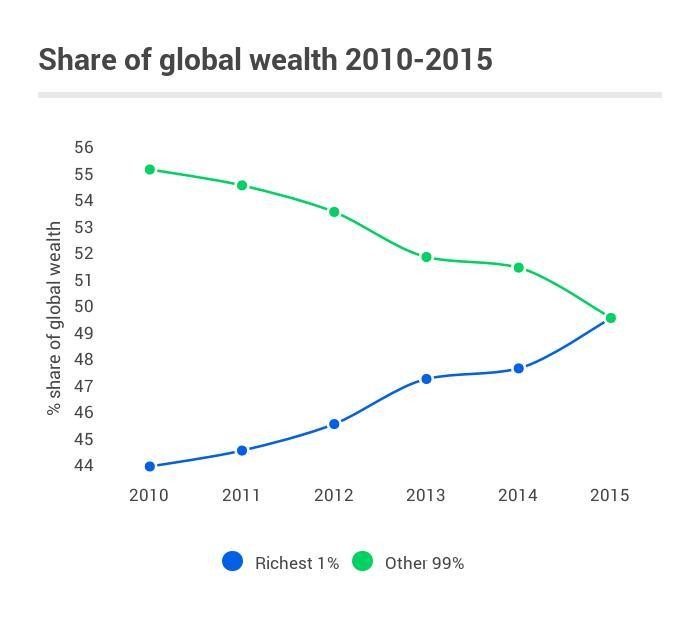
The second statistic is, nonetheless, more relevant and frightening. As reported by the World Economic Forum — since 2015 — the planet has reached the impressive record of at least 99% of the world’s wealth being concentrated henceforth in the hands of only 1% of the population, with the tiniest detail: half of humankind will own less than 0.7%. But, although this statistic is indeed something negative, what would be its relationship with the whole economy? In a simple explanation, this disparity in the distribution ends up by drastically shrinking the global consumer market, in other words, without buying and selling, capitalism does not work.
These last data set the grounds for the reasoning behind the graph that synthesizes the insufficiency of the Left and the Right as economic guidelines: economic growth vs social inequality. Its construction has taken a long time to be accepted by the economists, nevertheless, its logic is very easy to understand.
First, imagine a society in which all the income is concentrated in the
hands of a few — a scenario analogous to the medieval age —,
it is then not so difficult to realize that economic growth would be
close to zero, after all there is no buy-and-sell mechanism. Now, let us
focus on the other end of the graph, where economic equality is complete
and absolute: intuitively, there would also not be much economic
advance, after all, the absence of meritocracy would not reward the
above the average effort of any individual — note that, in this
hypothesis, there would still be growth: as long as there are people who
like what they do, there is no absolute need for extra
benefits
As we implement meritocracy on both extremes, be it by rewarding more
even or unevenly, the buy-and-sell mechanism is reactivated, and, thus,
economic growth gets a boost. Logically, as there are almost zeros on
both sides and we know that economic growth can be bigger than zero,
this implies that, somewhere in the middle, there is at least one peak
or optimum. The doubt about the uniqueness of this point of maximum has
not yet been resolved by the scientific community, still, there is
already an overwhelming amount of clues indicating it is indeed unique.
Many studies, models and statistics reveal that incrementing the income
of the wealthier part of the population ends up diminishing the pace of
the economy (a 1% increase of the income of the top 20%, reduces growth
by at least 0.08% in 5 years, according to the International Monetary
Fund
After establishing the graph’s shape — an inverted “U” or a
parabola with a downward concavity —, we can at last discuss the
problematic dichotomy of the Right and Left. Both sides err because they
do not optimize economic growth — advocating, in reality, zeros as
ideals —, be it by the absence of meritocracy or by an indirectly
verified extreme wealth concentration. However, given the reality, the
mistake of the Right is harder to forgive: to defend (neo)liberalism
after consciously knowing the aforementioned statistics is nothing less
than promoting poverty and strengthening even more the power of the
rich
So, how can we change the economic prognosis to something healthier?
Briefly, the primordial is the focus on the more pragmatic, an ideology
which would prime for efficiency and not for the Left or the Right,
i.e., if one day we happen to be closer to the leftmost extreme of the
graph (and to the left of the optimal point): that even the supposedly
leftists advocate for less income redistribution! There is no more room
to accept incomplete or flagrantly wrong theories, formulated in an era
when there were not enough data to assuredly prove them