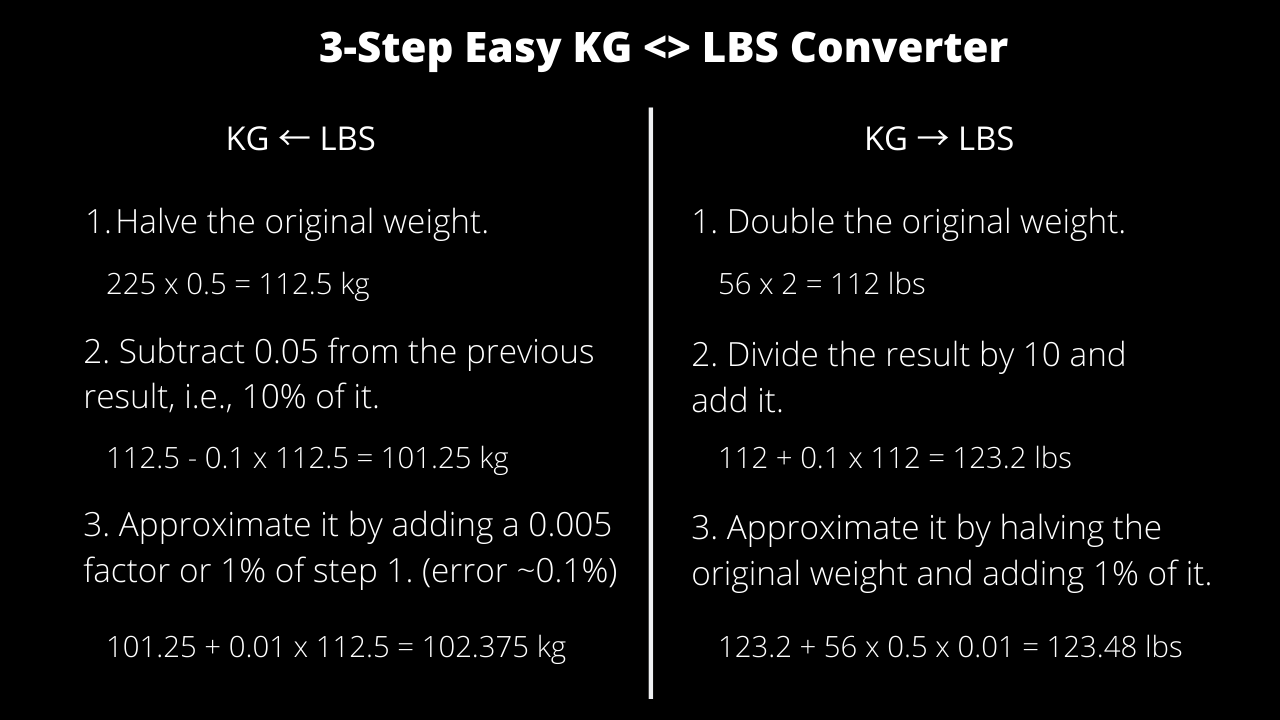
3-Step Easy KG ⇄ LBS Converter
Everyone that had to talk to people from the US knows how annoying it is to have to convert their units to the rest of the world's. And, now, with the rapid growth of Crossfit, this issue will only get worse.
I'll leave aside my urge to yell "grow up and use the same, better
units as everyone else"

The main requisite here, which is going to make the transformation accessible, is simple operations — for example, sums and subtractions are allowed, while multiplications and divisions are only permitted if they are done with easy enough numbers, i.e., those most people can handle, like doubling, tripling, halving, etc. —, and what's going to make things really easy is to focus on successive approximations, with these same simple operations. These successive approximations are very important for engineers, specially decades ago, enabling on the fly complex project estimates.
Believe it or not, but these successive approximations are what's actually used in human calculator competitions. So, if you practice them enough, you will be much faster than resorting to calculators or your smartphone. They are also a huge topic in mathematics, one big example being the Taylor Series.
If you want a quick approximation, use only the first 2 steps of the algorithms below.
Let's start with the rough conversion to have an idea of our final
goal
\[ 1 \ kg = 2.20462262185 \ lbs \approx 2.205 \ lbs \]
For simplicity's sake, I'm gonna stick to using 2.205 as the conversion rate. Only if you're a strength freak and can lift weights of up to 500 kg will the difference be relevant, and, even then, it would only amount to 0.0004 [latex] \cdot [/latex] 500 = 0.2 kg. If you're in that category and want precision, use the extra decimal places with the same flow shown in the following algorithm, but it might be better to just use a calculator anyway.
In order to convert a weight measurement from kg to lbs, say 56 kg, we simply multiply the weight by the conversion rate:
\[ 56 \ kg \cdot 2.205 = 123.48 \ lbs \]
Which is probably not how a human would comfortably approach this problem. It's much easier to, for example, multiply the weight by 2 and then add 20% for an easy approximation. And it's in that spirit that you can derive something like:
-
Multiply the original weight by 2, and memorize it.
- \( 56 \cdot 2 = 112 \ lbs \)
-
Divide the previous calculation by 10 and add to it.
- \( 112 + 112 \cdot \frac{1}{10} = 112 + 11.2 = 123.2 \ lbs \)
-
It's up to you if you wish more precision from now on. Usually, the
steps above are enough to get a good idea of what the weight is.
But, in any case, next, you could half the original weight, divide
the result by 100 and, finally, add it to the previous calculation.
- \( 123.2 + 56 \cdot \frac{1}{2} \cdot \frac{1}{100} = 123.2 + 28 \cdot \frac{1}{100} = 123.2 + 0.28 = 123.48 \ lbs \)
To summarize our algorithm, let's use \( x_{kg} \) as our original weight in kilograms before conversion, \( x_{lbs} \) as our weight in pounds after the conversion and \( y \) as the intermediate values. The right arrow means that we should overwrite our previous value — of, say, \( y \) — with the calculation on the right.
- \( y \leftarrow 2 \cdot x_{kg} \)
- \( y \leftarrow y + y \cdot \frac{1}{10} \)
- \( x_{lbs} \leftarrow y + x_{kg} \cdot \frac{1}{2} \cdot \frac{1}{100} \)
The counter part conversion can be found by simply "reversing" the
previous one
\[ 1 \ lb = \frac{1 \ kg}{2.20462262185} = 0.4535923699997481 \ kg \approx 0.454 \ kg \]
Again, I will not bother to use more than 3 decimal digits of precision. For huge weights of more than 200 kg, our imprecision will be around 200 \( \cdot \) 0.00041 = 0.082 kg, not even 100 g. There's also the fact that, since we are multiplying by something smaller than 1, any mistakes or imprecisions we end up making will be seemingly minimized.
Let's take the example of 225 lbs, which is the common substitute for 100 kg:
\[ 225 \ lb \cdot 0.454 = 102.15 \ kg \]
If we try to come up with the same answer but via approximations:-
Halve the original weight.
- \( 225 \cdot \frac{1}{2} = 112.5 \ kg \)
-
Subtract 0.05 from the previous result, i.e., 10% of it:
- \( 112.5 \ - \ 112.5 \cdot \frac{1}{10} = 112.5 \ - \ 11.25 = 101.25 \ kg \)
-
This should be precise enough for most use cases, but you could keep
going. I would suggest adding a 0.005 factor instead of 0.004 (from
the original 0.454), since it seems close enough and much easier
(we're going to miss by 225 g), which means we should take 1% of
step 1's result and add it to step 2's. We will miss our mark by
0.1%, so, if you wish, add a step 4 where you subtract 1/1000 from
the original weight in pounds.
- \( 101.25 + 112.5 \cdot \frac{1}{100} = 101.25 + 1.125 = 102.375 \ kg \)
To summarize this other algorithm, we take a similar notation to the previous converter with \( x_{lbs} \) as our original weight in pounds, \( x_{kg} \) as the result of the conversion in kilograms and \( y \) for intermediate results. Again, the right arrow means that we should overwrite our previous value — of, say, \( y \) — with the calculation on the right.
- \( y \leftarrow x_{lbs} \cdot \frac{1}{2} \)
- \( y \leftarrow y \ - \ y \cdot \frac{1}{10} \)
- \( x_{kg} \leftarrow y + y \cdot \frac{1}{100} \)
Will you use these algorithms? I think it depends more on you opening your own mindset and making a (small) effort of memorizing these recipes than whatever amazing magical methods I could come up with.
In the end, though, practically speaking, the biggest difficulty most people will have is probably trying to manage the numbers in their memory while having perform calculations in parallel. But it's not that much, I assure you. With a little bit of training and persistence, you can surely do it.
- For both conversions, you will have to manage 3 numbers, the (intermediate) result, the original weight, and, sometimes, one of the results of a multiplication or division.
- For converting kg to lbs, you will have to perform 2 sums, 1 multiplication and 3 divisions.
- For converting lbs to kg, you will have to perform 1 sum, 1 subtraction and 3 divisions.