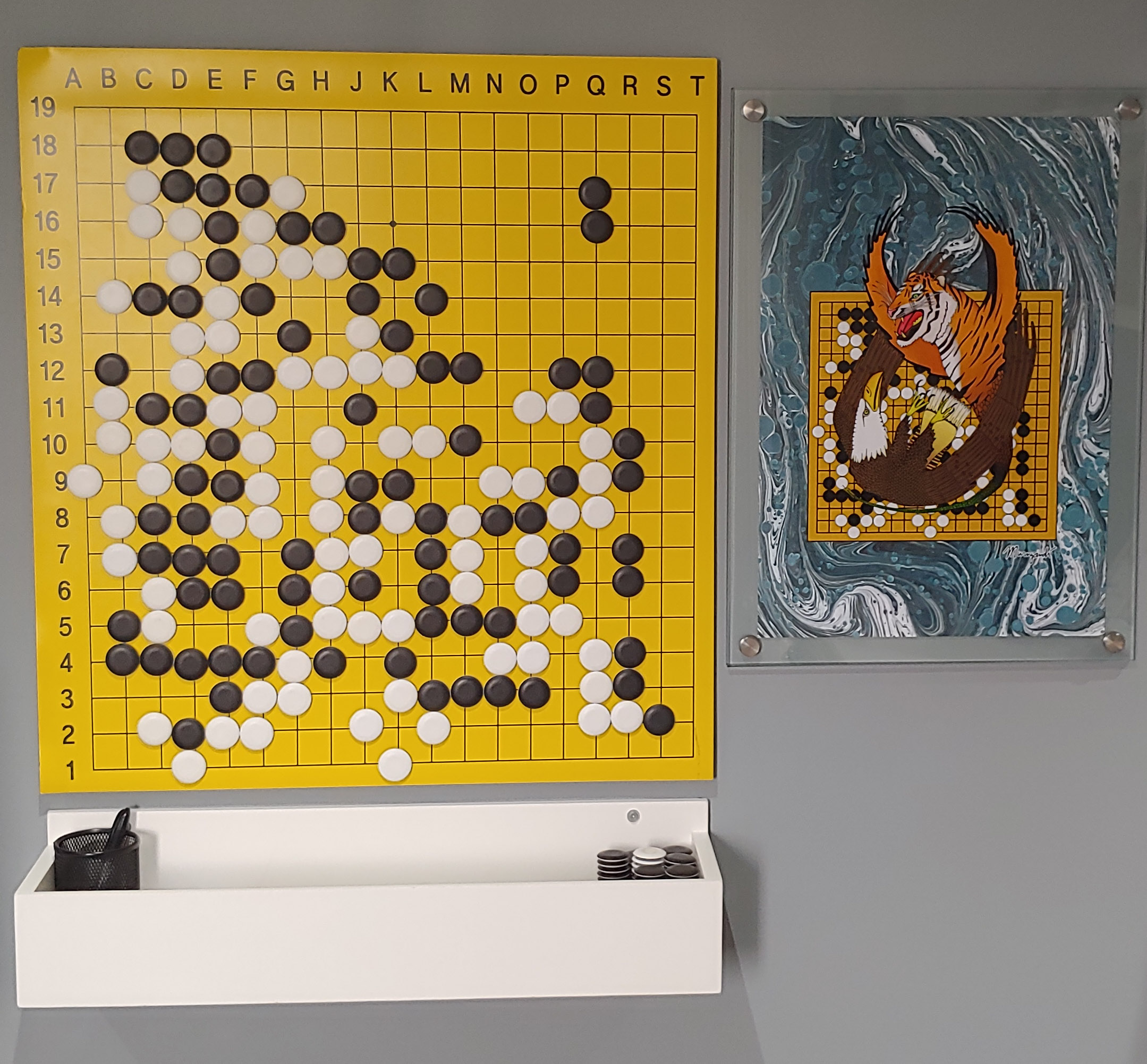
Murugandi's Fighting Spirit Design
You can download the SGF bundle here, including the transcription of Murugandi's commentary of Fan Xiping vs Shi Xiangxia.
PT-BR: O vídeo em português está aqui.
I should also thank the help of my good friend Simão Gonçalves in making a final review of the video.
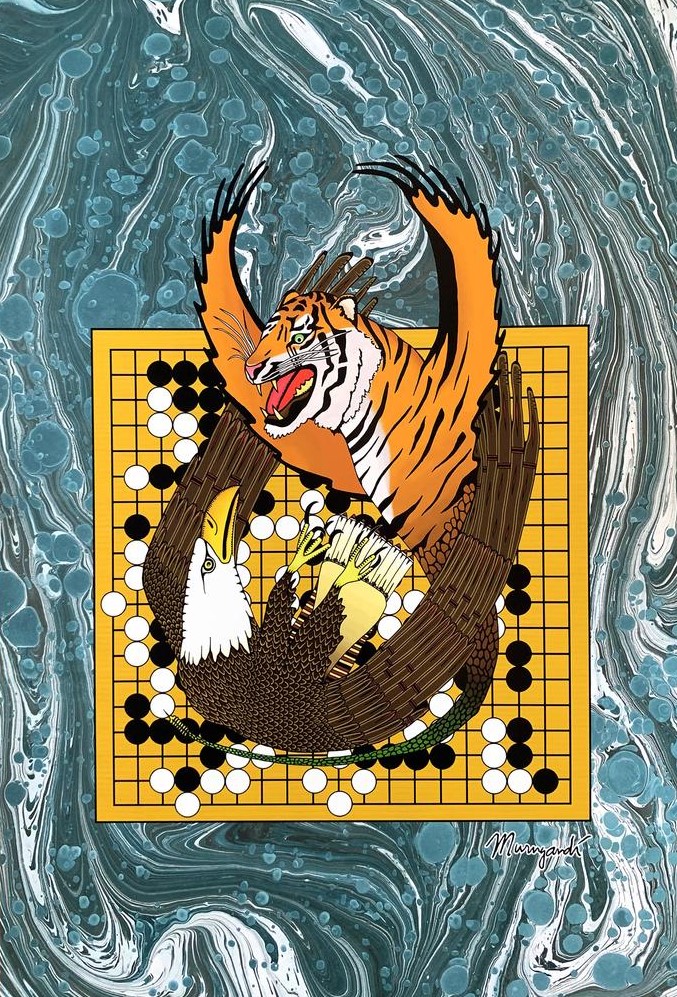
The design above, called Fighting Spirit, by
Murugandi
Kiai! Originally an illustration to the French book "Les Chants de Maldoror" written by Le Comte de Lautréamont (1868), pseudonym of Isidore Ducasse. In the book the main character Maldoror takes on the form of a giant eagle to fight God, who is half dragon-tiger, half serpent. The board position is from a game from the 18th century between legendary go player Fan Xiping (black) and Liang Weijin (white), known as "nailing down the guoshou title".
Ever since buying the print design, I've been planning on creating a review for this, or at least mostly transcribing a professional review somewhere. However, so far, I haven't been able to find a professional review anywhere. So I had to resort to my 1-2d KGS monkey brain. Luckily, nowadays, we can also use super strong AIs to help us, and that's exactly what I did: besides my first unbiased review, I've used Leela Zero Big (ELO 16190 at 2k Variations) to help me specially with the more complicated moves.
It should also be noted that having White start and no komi for Black really does distort Leela's plays, specially at near the end of the game. Leela might choose inferior moves because it wrongly thinks the advantage is bigger than it really is.
Another quite helpful resource was
Murugandi's review of Fan Xiping vs Shi Xiangxia
I've used Sabaki to edit this game, so other editors might not display the same amount of metadata, including the one below.
Your browser doesn't support the WGo.js Player. Please use a more modern browser, like Brave, Chrome, Firefox or Edge.
This is one of the games of the Games of Wonder book, by Jun Wu and Jiong Wu. This game is also known as nailing down the guoshou title — Black 162 is seen as a nail, hence the pun —, because that's how Fan Xiping earned his. Guoshou means national hand or national treasure. Fan Xiping became guoshou at the age of 16. Shi Xiangxia is also known as Shi Ding'an.
These games are known for:
- Crazy games with a lot of exchanges, groups and tenukis.
-
The rules are not modern Chinese nor Japanese, but Ancient Chinese.
-
Each group has a 2-point penalty to it — actually it's
more accurate to say:
if one player had more living groups than the other, then
every additional group costs 1 stone (2 points).
- A group must have 2 eyes to live.
- This incentivizes sacrificing and cutting groups.
-
Cross hoshis start.
- It somewhat compensates for the advantage of having to play first.
- It is also related to symmetry. Yin-Yang philosophy was so important to China that it even seeped into Go. It is also said that it represents the alternating 4 seasons, and that Black and White would represent night and day, respectively.
- White starts.
-
Each group has a 2-point penalty to it — actually it's
more accurate to say:
if one player had more living groups than the other, then
every additional group costs 1 stone (2 points).
- From a Jubango — Best of 10 — they played.
- Ogeima and wide cross pincers were very common in the fuseki.
There exists commentary of this game by the late legendary Chen Zude 9p: Ancient Chinese Go Games with Detailed Commentary Series, but the whole book hasn't been translated to English yet apparently.