Venn Diagram of Negative Language

Negative Language: WHY you should avoid it

Until recently, I had not given that much attention to one habit we humans have: negative language. This is done primarily by those who teach — not necessarily teachers, they could be bosses for example, which is probably the most common case nowadays. The issue with this kind of language is that it is mostly incredibly vague: it tells us what not to do in the hopes that, with such a marvelous hint, the student will be able to narrow down the entire universe of possible actions to the only ones that are in fact correct. Needless to say that the master’s hopes are naïve at best.

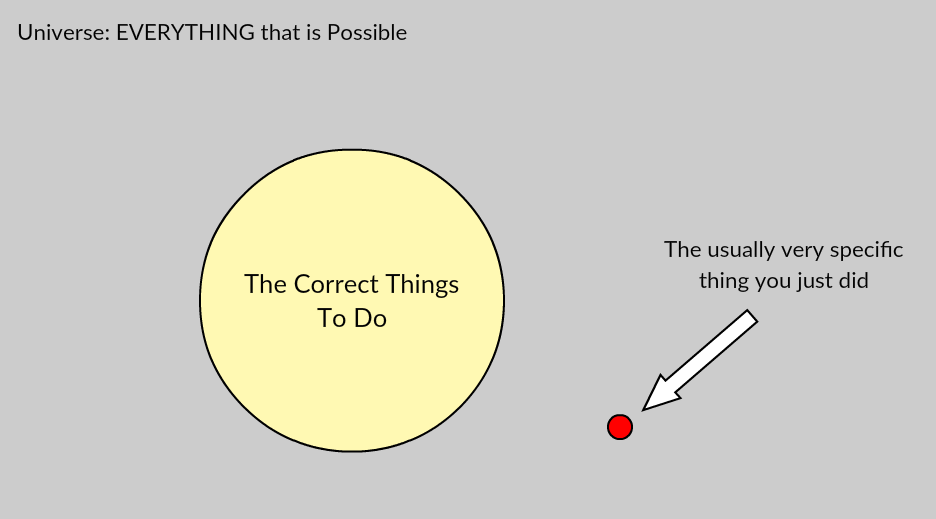
My reasoning can be more clearly understood with the help of the Venn Diagram below:

Venn Diagram of Negative Language
The problem with Negative Language: not being specific about what you should do.

The grey area is everything you could do, and the yellow one, what should be done. Unfortunately, frequently, we will end up in places such as the red dot, where our teacher/boss will happily reprimend us and think that enough information has been provided . Surely it helps to say we were wrong, it’s better than nothing, but it’s unexpectedly devoid of much content. In the end, we are left with the negation of the red dot as the possibly correct actions, resulting in a lot of other painful attempts until we reach the yellow circle. This type of language is, coincidentally, what most Asian masters in movies use, and exactly that which is very often repudiated by most experts as being a terrible waste of time and expertise.

Negative Language is also not welcome in many other topics, such as Nonviolent Communication, as the type of language that stifles the brain. And the reason is basically self-evident after what was discussed: we end up with too big an area to look for answers and, thus, we are simply overwhelmed by the amount of possible actions in the search space.

Eventually, it all boils down to something I’ve learned through Go — and martial arts —: a punch to the face will (almost) always beat (fluffy) indirect movements; i.e., use direct and positive assertions, not indirect information or circumventions.