On Korea: A Brief Summary of My Experience
After 24 hours inside airplanes, more than 10 hours waiting on airports, 2 connections, and 2 more hours in a bus, I finally arrive at the hotel. To enter the building, I pass through the outward doors with my hefty luggage, but, as I go through the second, an ill-calibrated timer closes it on me, making me stuck at the entrance of the main hall: while a paralyzed hostess watches the scene struggling to come up with a solution, I have a strange premonition that this whole situation will be a metaphor of my incoming stay in the country.
For those who don’t know my background — for those who do, please bear with me this n-th repetition of the same story —, throughout university, during my bachelors degree in engineering, I saw my interest in the field wane: the jumbled world of abstractions presented by the professors seemed only to needlessly complicate a world that was much simpler in the daily practice. As a result, I couldn’t help but erroneously generalize the feeling of emptiness to life itself.
I could even argue that this hole, the death or coma of interest, was the main reason why I decided to take part in an exchange program in Europe one year and a half earlier. Consciously, I deeply wanted my love for science to rekindle during my stay in the old continent, however, subconsciously, my general interest for life was at stake.
That somewhat brief one year period revolutionized my life. Unexpectedly, Go — Baduk or Weiqi —, a hobby I learned in my second year at university, brought me a family which taught me the real value of friendship, a new language — French — and a lifelong set of lessons I’m still learning from.
Coming back to my last semester in my original university I soon
realized the diagnosis of my lack of interest was worse than before
with respect to my courses. Only Go would shine in my mind
Obviously worried about my future, I didn’t want to land on the other
side of the globe without a plan. The first choice that comes to mind
is to go for the intense monk-like training inseis tend to have.
However, this did not seem to be a good prospect, as I would most
likely not become as strong
At the time all this internal storm was raging, my interest for the exact sciences was, as previously mentioned, essentially dead. With the puzzling effect of my experience in Europe, I couldn’t help but gradually dive into the mysteries of social interactions. Eventually, the question I was internally urged to solve became more clear: with respect to Go — and, more generally, board games — what would be the set of good behaviors and attitudes which would most likely yield a good social interaction? Hopefully, answering that enigma would make me and many others able to better control the environment of a Go Club, letting the game be more enjoyable and the related emotions less of an issue.
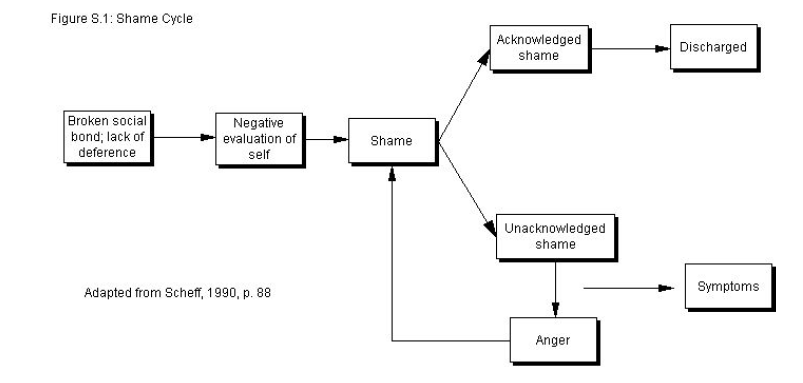
That question is mostly a subject of the not so well known — much to the shame of academics — field of microsociology, the middle child of the sociology and psychology brothers. This field studies interactions within groups of individuals and is sometimes considered a black sheep due to the fact that you can’t use reliable statistics like you do in sociology — since the population is too small — and neither can you blindly generalize the extensive body of work psychology has created for the behavior of individuals. Nevertheless, there are some important concepts which have been safely confirmed; and, probably, the most relevant to the aforementioned question is the Shame Loop.
The Shame Loop has been a recurrent topic for psychologists
and nothing really new, however it does not only have an effect on the
individual but, also, on the interaction. In simple terms, whenever
someone becomes a victim of shame, he or she tends to lower
self-esteem, to the point of causing more shame and, thus, creating a
destructive spiral. But, in a less expected manner, this spiral also
acts on the interaction between individuals, because it is observed
that when one of the actors demonstrates that he or she is ashamed,
the other person will most likely also feel ashamed for making the
other ashamed, and so on, shaping another spiral. This phenomenon can
be seen in various social occasions, and I would argue that it’s very
frequent in Go: rarely will you see players who take losing healthily;
and no wonder the more emotionally stable players are usually the
stronger ones
The basic advice psychologists would give you to dispell the
Shame Loop is to be conscious about the phenomenon —
acknowledging it helps it to not be transformed into general anger or
indifference — and to be surrounded by loving people who can
help you overcome it. But Thomas J. Scheff, in his
chef-d’œuvre
Microsociology
After settling for the mix of academic research and Go training, I spent some time trying to find a suitable institution which would help me achieve my goals. It was mostly difficult to find any, since my requisites were very specific and the language barrier was enormous – I only had some rudiments of Chinese. Eventually, I converged to basically the only institution that had a seemingly reasonable fit: Myongji University, more specifically the Department of Baduk Studies. This school was founded by Professor Jeong Suhyeon (정 수혀), a psychologist and Korean 9p, credentials which, at least at a superficial level, helped assure me the department had some rigor.
However, once in South Korea — and also before arriving there —, I started to realize that some things were off.
The most flagrant one was the fact that there were very few Westerners in the Department. Despite so many ardent Go lovers in the West, only a handful of them were there and none in my year — I had only one colleague in my year of the Master’s program, a young Chinese economist. Although the Department incentivized — mostly with full scholarships — foreigners to come and study there, after 20 years of existence, most of them wouldn’t take the offer. And the reason comes from two factors.
Firstly, the school was created to satiate a need: as Go grew in popularity in South Korea, more and more people would like to take it as profession, but, having no credentials and no other skills besides playing, a lot of people would end up unemployed, and a lot of professionals, with insufficient income. The Department of Baduk Studies gave these individuals sufficient technical means for teaching Go and credentials which would enable them to be valued by society, surely an accomplishment worthy of praise. This whole environment, however, was never intended to those who sought different goals and, thus, Westerners would invariably be disappointed.
In second place as an issue, I would rank the academic deficit. I do not recall, in my one semester stay, having heard of any paper or research that came out of this Department as being relevant to any other fields, though, again, 20 years have gone by. And it is not as if their field were anything new, it is just an application of much wider areas of knowledge, such as psychology, history and game theory. In my opinion, this school lacks a strong academic leadership, which could be achieved through catering Go loving researchers, who are, in fact, sufficiently numerous for that purpose.
Another problem that deeply disappointed me is the inexistence of a
systematic method of improving the strength of the students. Due to
many, if not most, of the students already being professionals or very
high ranked amateurs, I believe the professors saw no gain in having
some kind of league or training to improve the students’ strength;
but, to the international ones, it feels like staying for years in the
Shaolin Temple and being able to, at best, only watch the monks train.
Of course, the underlying work to manage such a system would be too
much for the professors alone, but they could, for example, much like
in monasteries, make it mandatory for stronger students to help weaker
ones or just outright hire Go teachers: after all, having a Department
of Baduk Studies which does not directly include studying the game
feels wrong at a core level
Overall, my critique of the school is negative, but I must stress the fact that the people I met there were very kind and welcoming. The professors, for instance, mostly helped me whenever possible and even tried to convince me to stay when I decided to quit the Master’s degree. And, probably, the biggest benefit of being part of the program is the independence they will give you, specially if you can do the work by yourself. If you wish to know more about it, feel free to message me through Facebook or get in touch with Prof. Daniela Trinks, who is the main point of contact for Westerners in the Department.
By far this was my biggest underestimation in years. From gleaning
through Korean textbooks, after learning the alphabet, you will
probably have the impression that this is an easy language, or, at the
very least, the easiest among the Asian ones. Wrong
What King Sejong (세종), the historical father of modern Korean, did was, at its surface, marvellous, a beautiful simplification. Nonetheless, the Chinese background still remains, which makes things very unexpectedly confusing to learn. King Sejong replaced the Chinese ideograms for an alphabet, which makes writing much simpler, since you don’t need to memorize thousands of symbols anymore, however, this also brings a lot of other sources of mistakes, because, now, all the inherent Chinese homophones have also become homographs, thus having essentially no way of differentiating themselves. In other words, you will end up with a lot of words that, for different contexts, will have completely different meanings — this also greatly diminishes the value of dictionaries, since definitions cannot be very concise anymore. Homographs and homophones are normal for basically every language, but the sheer scale they take in Korean is just appalling, frightening, for any beginner, who will be second guessing every phrase he or she hears or, even, reads.
However, when I mention my massive underestimation, I’m actually referring to my approach of learning the language. My plan was to learn it on the go and only when I needed to, after all, my main interests were Go and psychology, not Korean. This is very unlike my general attitude towards languages, which is generally of considerable interest; but, in the case of Korean, I couldn’t help but feel hopeless once I realized that the vast majority of the resources I could use as a beginner came from pop culture, an area mostly lacking in content quality. As a result, the more I tried to learn Korean, the more I wished I had stuck to Chinese instead, with their bigger, longer, stronger cultural heritage.
In sum, it is clear that learning Korean — or any language, really — the way I tried to is a recipe of failure. Instead, it would have been much more effective to follow the path many Westerners and some other Asian foreigners took — and that only much later I discovered I was eligible to —: take a semester or a year of sole dedication to the language, in a program most South Korean Universities offer, with steep discounts for their graduate students. I don’t know if I would have gone to South Korea if such a program were mandatory, but it was at least a worthwhile consideration.
It is true that I haven’t traveled that much in South Korea —
nor have I spent that much time there —, so this won’t be an as
comprehensive a guide as I would like it to be. Nevertheless, I’ve had
enough experience in some of the more important environments, that is,
those most people will likely spend the majority of their time
in
Korea has become the embodiment of all of the capitalist principles, a
country that works: which does not necessarily mean
fulfillment
One curious side effect of it is related to the book shop density in the big cities. I was very surprised to almost not find a book shop in the medium sized town I was living in — Yongin (용인) —, and how sparse book shops in Seoul (서울) are — you may have to Google for them in order to find one. In comparison with Western large developed cities, where you can find a book store within some blocks or, at least, in every shopping mall, I was a bit baffled by Korea. Besides the internet, the only explanation I could arrive at is that their education, though high in many standards, is mostly utilitarian and competitively oppressive, a perspective which does not usually incentivizes the reader to keep on learning.
n the end, the final form of capitalism seems to be a Korean marketplace — with many offices on top —, where people both work and buy, all in one place, and where people can also have a break from their tiresome schedules by playing bowling with their work colleagues or having overnight Starcraft sessions, or, perhaps when feeling too much stress, release their anger violently, inside a bat cage.
Obviously, this is just my opinion, which I mostly focused on the aspects that affect the majority of the population, and which I found most memorable and wicked. Though South Korea has a lot of facets I believe are just flat out wrong or bad for human existence, I must make a concession to state that their people are overall some of most compassionate I’ve ever met. Despite the occasional feeling of being a zoo attraction of the Western subspecies, spending time with them is mostly very pleasant.
After my final decision of quitting Myongji was made, I still had
about 45 days before my flight back home. Although I could move it
forward I chose to stay and try out a more intense training
experience. Since I already had some friendship with the people at
BIBA
My initial idea was to stay more than 45 days if I liked the
experience, however, eventually, money also took its toll in
convincing me to go back at the previously scheduled date. BIBA has
its pros and cons
I’ve learned a lot from the teachers there, specially when it comes to
training — Diana’s unbelievable persistence at teaching me how
to solve tsumegos… — and another much more pragmatic approach to
Go. The last days in the school were tough on my completely exhausted
self, I had doubts all over the place about my future and felt an
utmost disappointment at how big a failure this attempt of a new life
based on Go on the other side of the planet was, but, at least, BIBA
gave me a sensation of closure, a more open mind, and taught me the
value of repetition — not to mention the necessary wisdom to
arrive at the meaning of life
For a long time I’ve been trying to learn from my stay in South Korea — about one year now —, and I’ve come up with a miscellanea of explanations for why it didn’t work out and why I eventually decided to quit. In a concise summary: it wasn’t worth it — which is a totally subjective statement.
During my stay, I saw students, friends and professionals put an ungodly amount of work into Go only to be recognized as marginally valuable by others and, in doing so, they would invariably have to let go of other pursuits for knowledge, either due to a lack of time or a lack of energy, something my personality absolutely cannot stand, as I view specialization as a consequence and not a primary objective — which is a bad perspective for life nowadays, since capitalism basically only values specialized intellect.
In parallel, I saw myself fully committed in a Master’s program I found more and more questionable both in terms of helping me achieve my desired goals as a researcher and in terms of financial prospects, while having to bash my head against the Korean language everyday and face the naturally subtle ostracization of Korean society. Ultimately, my passion for Go did not cut it — in fact, it remains in a coma to this day, mainly only creating online educational content for beginners.
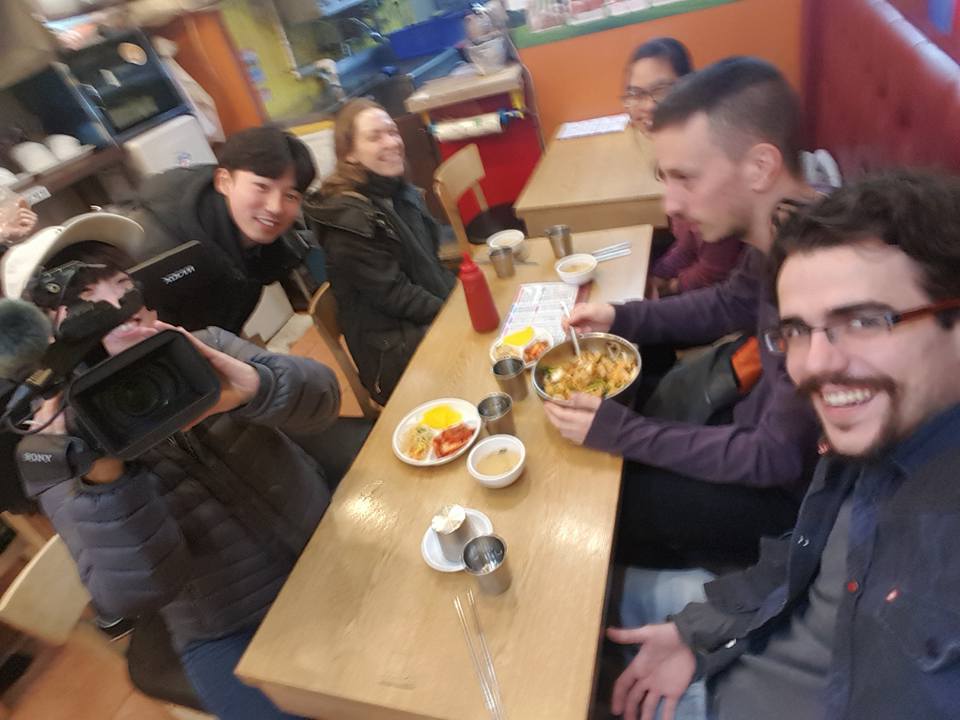
At the very end, in one of my last days, as I ate with the other BIBA students while being filmed by a TV crew of a documentary on international Go players in South Korea, I became paralyzed by fear and sadness, remembering the infinite set of doors I had got stuck in, when they asked: what will you miss about Korea?