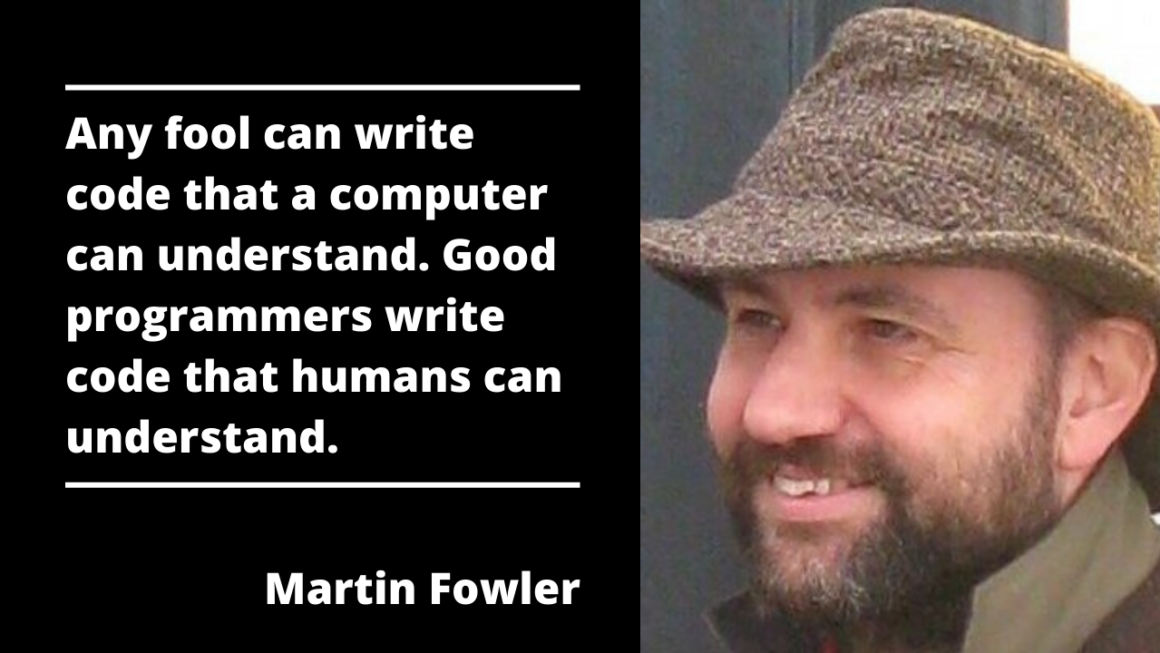
Quote #3 - Martin Fowler on Good Code (and engineering in general)
Any fool can write code that a computer can understand. Good programmers write code that humans can understand.
Even though you might admire the elegance of code which uses the extremely succinct \(i, j, k, \mathrm{fft}(x)\)... notations for variables and assignments, the truth is they are incredibly difficult to manage in a larger-than-one-file codebase. And that's not because that math is complicated but rather because you're fooling yourself for thinking that making an abstraction visually succinct will make its complexity disappear.
Just because the letter \(i\) is smaller than the words "row" or
"column" doesn't mean your brain will automatically attach meaning to
it. In reality, every time you try to understand code with this sort of
scientific notation, in your head, you will try to associate the symbols
to their meanings, which creates a ton of mental friction when trying to
understand the whole. So why not simply write "row" instead of this
dreaded \(i\) and eliminate the friction altogether?
I would add to Fowler's quote that we should not only write code that humans can understand but rather understand it easily. Developing with a team in a codebase where every line contains a bit of mental friction is not only unpleasant but unsustainable. Mad looks, wtfs, anger and resentment will quickly get even bigger than the code itself.
The quote above can also be further generalized into the importance of not only taking care of the what — the product itself — but the how — the means. If, for example, you want to develop a wheel, ideally, you wouldn't have to also develop a vehicle, like a car, in order to test it. You would simply create a rod you could spin and attach it to the wheel. This equipment would be you taking care of the most optimal way of how to develop the wheel, which, arguably, is a product in and of itself, a metaproduct.
Developing a vehicle to test the wheel may seem like good enough. It tests the product in the end anyway, doesn't it? But it's much worse than you would initially believe it to be. One big reason is that it creates a multivariate issue, i.e., you're not testing the wheel in isolation anymore, you're testing the whole system; so, if something isn't playing out as expected, how would you unambiguously say it's due to the wheel and not any other part of the vehicle?
The other reason — and the one that is much closer to Fowler's quote — is that it adds a lot of noise, inconvenience and useless stuff to what you want to test. Imagine the routine of someone who wants to test the vehicle-wheel setup: every day the person would have to make the whole thing work in order to test even the smallest of the parts. If the setup were simpler, the management cost would be that of only a simple rod.
And all this discussion is, to me, (at) the heart of engineering. After
bashing my head against many walls throughout the past years, I've come
to firmly disagree with blunt definitions like the one propagated by the
American Engineers' Council for Professional Development