Ali Trump and the 40 Ghost Supporters
This post is a (very) short word analysis of U.S.A.’s presidential speeches — it will be clearer later what that means. Sorry if you think the title was rather clickbaity :P.
The whole dataset for this mini-project is composed by the 12 last presidential speeches of all presidents going from Trump to Eisenhower — though I won’t use Eisenhower’s data because there is not that much available. The other presidents were less relevant — due to the much different textual patterns; quite frankly, I should have stopped much earlier than Eisenhower — and much trickier to get, so I decided to stop at the 34th one.
All of the text comes from University of Virginia’s Miller Center, and I’ve written a Python web scraping code to get it in a more automated way. I won’t paste the code here, but you can check it at this Github Repo.
The reason why I started this mini-project is that, when listening to Trump, I can’t help but have the impression he is trying to hypnotize the spectator with the repetition of a set of words to compensate for his lack of content or unconsciously mischieveous intentions. A rather biased project I must admit, but maybe I can lessen the bad taste with a similar analysis of other presidents; and, as you will see, the difference, for example, between him and Obama is much smaller than one would estimate beforehand.
When it comes to analyzing words, it is common practice in Natural Language Processing to eliminate the so-called “stop words”. These are repeated words in the text that are mostly only useful for grammar or connections, which don’t add a lot of information overall; some examples are: “I”, “me”, “myself”, “the”, “a”, “by”, etc. For this dataset I decided to include only “I” from all of the stop words that were excluded because — I had an inkling that the 45th president is a bit of narcissist.
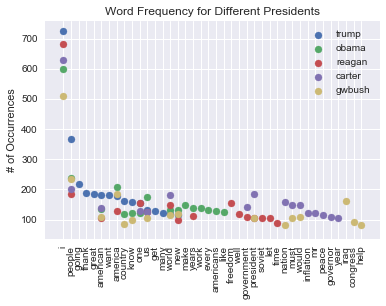
Here are two word frequency plots for different presidents:
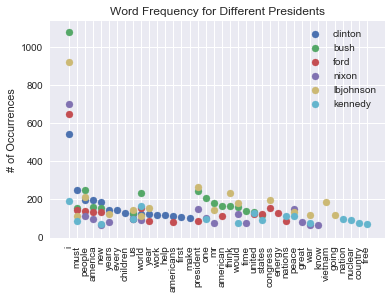
From the top graph, we can see that Trump likes to talk about himself even more than another populist president, Ronald Reagan. And I haven’t even commented the fact that the data from past presidents comes from their last speeches in office, which usually tends to be the ongoing president talking about his achievements; so for Trump to compete with or beat them in that situation is quite remarkable. Nonetheless, I’ll grant him a pass on a bigger analysis of his egotistic behavior, since the difference is of only about 20% — and presidents like G. H. W. Bush and L. B. Johnson seem to be weirdly way over the top — and, thus, would need more research.
Moving on, another more important pattern is very clear: Trump is addicted to — or perhaps he wants us to be addicted to — the word “people”, which is basically his way of validating whatever he says. The vast majority of the instances when he cites the word “people” is related to either him boasting about America or creating anonymous nonexistent beings that would prove him right, ranging from suffering partisans of his to “criminal” opponents. Here are some some examples of the latter strategy from within the dataset:
- I know people came up to me with tears in their eyes; they’re saying, I’m forced to pay not to have healthcare. Very unfair. — Even if that were true, it’s a logical fallacy. You don’t destroy everything because some of the subjects are being treated unfairly, it would be much better to just fix the issues with the outliers.
- Thank you, Mike. It’s amazing, generous. And I’ve watched the police and the fire—they come around and they’ve become so good at it. But I’ve seen people that are just about dead wake up. — what people? Somehow he has managed to credit and discredit a whole department at the same time.
- “Just talk about tax cuts. People don’t know what reform means. They think reform might mean it’s going up.” And I said, “Do tax cuts.” — Nope. Not everyone thinks like that. At all. And I would argue that the opposite is just as likely.
- Leaders in Washington imposed on the country an immigration policy that Americans never voted for, never asked for, and never approved—a policy where the wrong people are allowed into our country and the right people are rejected. — The former immigration policy could be wrong, but this generically bad outcome is nonexistent.
Interestingly, everything about Trump is aligned with the definition of a demagogue — and all that’s around the new wave of post-truth —: a political leader who seeks support by appealing to popular desires and prejudices rather than by using rational argument. Such a politician combined with the flagrant Russian support and a lying rate which has reached a whopping 10% of his discourse creates a threat to America (and the world) that is much bigger than what people might be led to believe.
Anyway, I will stop with my critique of Trump, otherwise this article will become a book.
This part is an extra, more for fun than anything else — and not at all serious —, so it will most likely not add any valuable information. It is only at your peril to keep reading.
Prior to the Deep Learning era, one of the techniques of text generation used entities called n-grams. These are connected structures in the text that would hopefully carry linguistic patterns with them. Here we will use bigrams, which will simply be two words next to each other. The concept behind text generation is to use the bigrams to assess the probability of the next word: so, for example, if we find out that, after the word “I”, the word “am” appears 90% of the time, our algorithm will generate “am” 90% of the time after it sees the word “I”. Simple as that.
Despite the above example, there are actually two ways of generating
phrases with this algorithm. The first one is to only get the word
which is most likely to appear as the next one, so we can take a
look at which are the favorite patterns of the given writer.
However, this inherently ends up in a fractal pattern
- Obama: I have a seat thank you so much thank you so much thank you so much thank you so much thank you so much thank you so much thank you (…)
- Trump: I don t know if you to our first lady melania who has been so incredible applause thank you to our first lady melania who has been so incredible applause (…)
- Clinton: I am profoundly grateful to speak to speak to speak to speak to speak to speak to speak to speak to speak to speak to speak to speak to speak (…)
- G. W. Bush — somehow the president that doesn’t know the conjugation of the verb to be: I are just delighted to be seated thank you all very much good luck please be seated thank you all very much good luck please be seated thank you all (…)
The other way of generating phrases is to do it as previously mentioned, assigning probabilities to each word encountered in the original corpus of text. This method yields more reasonably looking phrases, such as:
- Trump: I want to do things that threatens our nation state building up as a surprise to pay not acceptable in 65 years of a big deal my first lady michelle (…)
- Eisenhower: I would rapidly be intolerable if not be made essentially unchanged and do expect the contrary to serve the principles of the congress or alien force huge costs involved (…)
- Ford: I called for a global policy general revenue sharing we have seen most good night god guide this year through these times to defend ourselves reliable partner in a chance (…)
- L. B. Johnson: I have in withholdings deferments impoundings and we are making progress we have already completed that is a recommendation is absolutely necessary for wanting to enter into achievements but the (…)
In conclusion, indeed these are not the brightest phrases in the galaxy, nevertheless, given such a simplistic algorithm, I feel very impressed by the results. A Deep Neural Network would do much better at generating phrases and I might even try one next, now that I have the dataset. If you wish to improve what I did or just mess around with it, feel free to do so, the code is available at this Github Repo.