History of Go
| Go | |
| Genre | Abstract strategy game |
|---|---|
| Players | 2 |
| Origin | China |
Go is an abstract strategy board game for two players. It was invented in China more than 2,500 years ago and is believed to be the oldest board game continuously played to the present day. This page is a mock-up used to judge how a vertical timeline looks inside an article; the prose is placeholder.
The sections below are written in the usual article style, so that the timeline can be compared with ordinary headings, paragraphs and lists around it.
Early history
Placeholder paragraph about the early history of the game, the first written references, and its spread to Korea and Japan.
Timeline
Selected events in the history of the game.
-
1612
The Go academyThe Tokugawa shogunate patronises the game and forms the houses of professional players; Honinbo Sansa is appointed head.
-
c. 1651
Huang LongshiHuang Longshi (c. 1650 – c. 1694), one of the strongest players in history, is born.
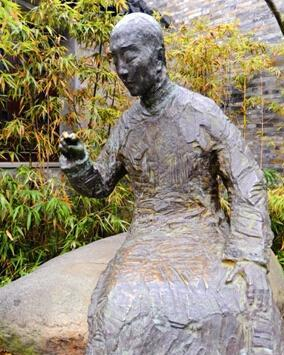 Huang Longshi
-
1846
The Ear-Reddening GameShusaku's move 127 stuns Gennan Inseki, and becomes one of the best moves of all time.
-
March 2016
AlphaGo defeats Lee SedolDeepMind's AlphaGo wins four games to one against Lee Sedol in Seoul.
Modern play
Placeholder paragraph about professional associations, rankings, and computer Go after 2016.
Computer Go: several events on one dot
When events share a date they sit side by side under one dot, and wrap when the page is narrow. Demo content; check dates before reuse.
-
1968
First Go programAlbert Zobrist writes the first program able to play a full game of Go.
-
2006
Crazy StoneRémi Coulom applies Monte Carlo tree search to Go.UCTKocsis and Szepesvári publish the UCT algorithm for tree search.
-
2016
AlphaGo defeats Lee SedolAlphaGo wins four games to one in Seoul.
-
2017
Ke JieAlphaGo beats the world number one, Ke Jie, three games to none.AlphaGo ZeroA version trained without human games is described in Nature.Open programsStrong open-source engines begin to appear for everyone to study.
Players, programs, organisations: parallel timelines
Separate timelines share a row and wrap when there is no horizontal space. Each keeps its own dates and rail, and they are independent: nothing lines up across them. Demo content; check dates before reuse.
-
1846
The Ear-Reddening GameShusaku's move 127 stuns Gennan Inseki.
-
March 2016
Lee Sedol wins game 4His move 78 is the only human win in the match.
-
November 2019
Lee Sedol retiresHe cites the rise of AI as a reason.
-
1968
First Go programAlbert Zobrist's program plays a full game.
-
2006
Crazy StoneMonte Carlo tree search arrives in Go.UCTThe UCT algorithm is published.
-
March 2016
AlphaGo wins the matchFour games to one.
-
1924
Nihon Ki-inThe Japanese Go association is founded in Tokyo.
-
1945
Hanguk KiwonThe Korea Baduk Association is founded.
Parallel and grouped timelines
The same three timelines, grouped: their dots line up horizontally. The March 2016 events of Players and Programs sit on one row, and a timeline with nothing on a row skips it. Aligned columns cannot wrap, so below 640 px the group falls back to the independent layout above; narrow the viewer to see it switch.
-
1846
The Ear-Reddening GameShusaku's move 127 stuns Gennan Inseki.
-
March 2016
Lee Sedol wins game 4His move 78 is the only human win in the match.
-
November 2019
Lee Sedol retiresHe cites the rise of AI as a reason.
-
1968
First Go programAlbert Zobrist's program plays a full game.
-
2006
Crazy StoneMonte Carlo tree search arrives in Go.UCTThe UCT algorithm is published.
-
March 2016
AlphaGo wins the matchFour games to one.
-
1924
Nihon Ki-inThe Japanese Go association is founded in Tokyo.
-
1945
Hanguk KiwonThe Korea Baduk Association is founded.
See also
References
- Placeholder reference.